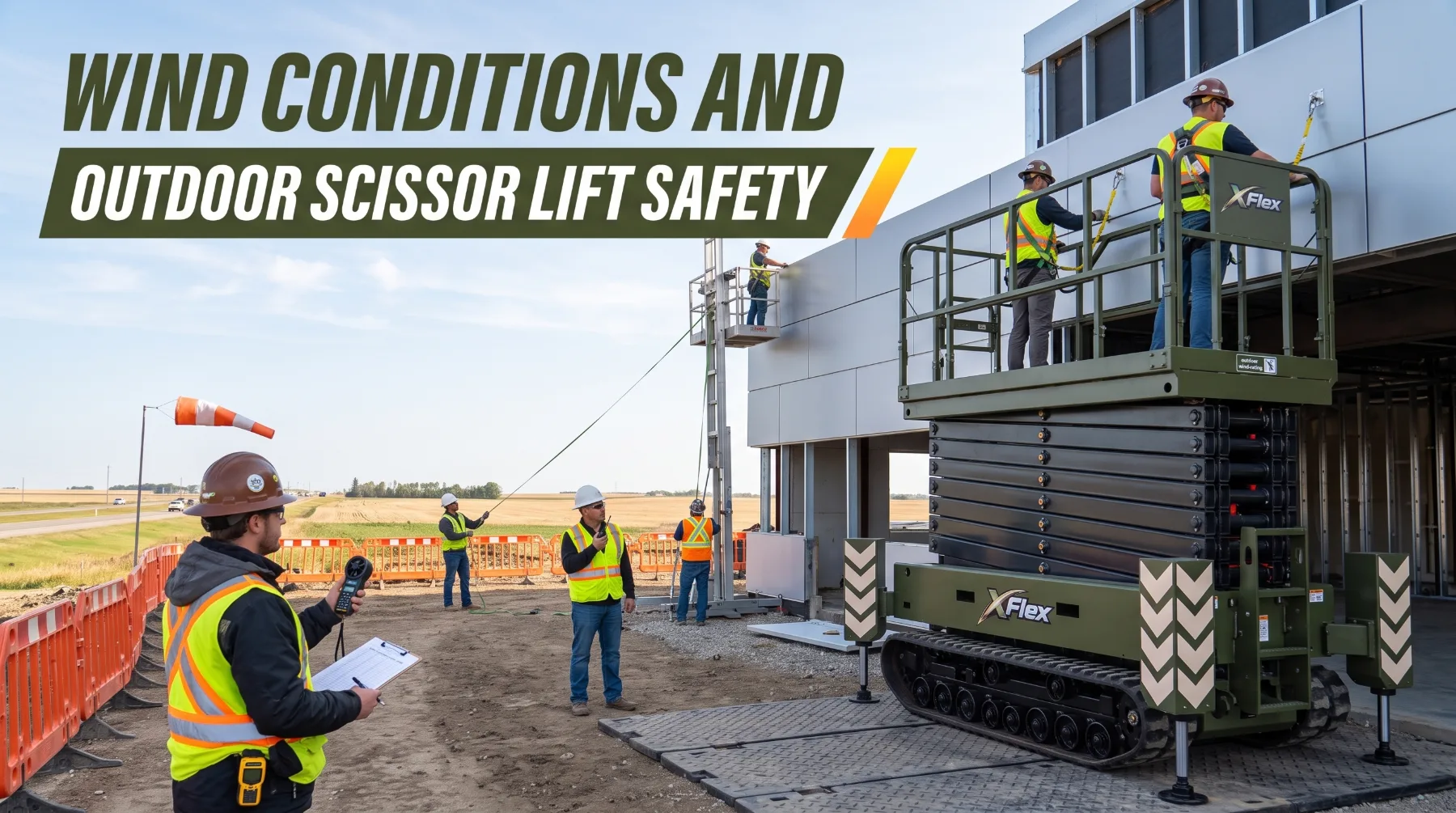
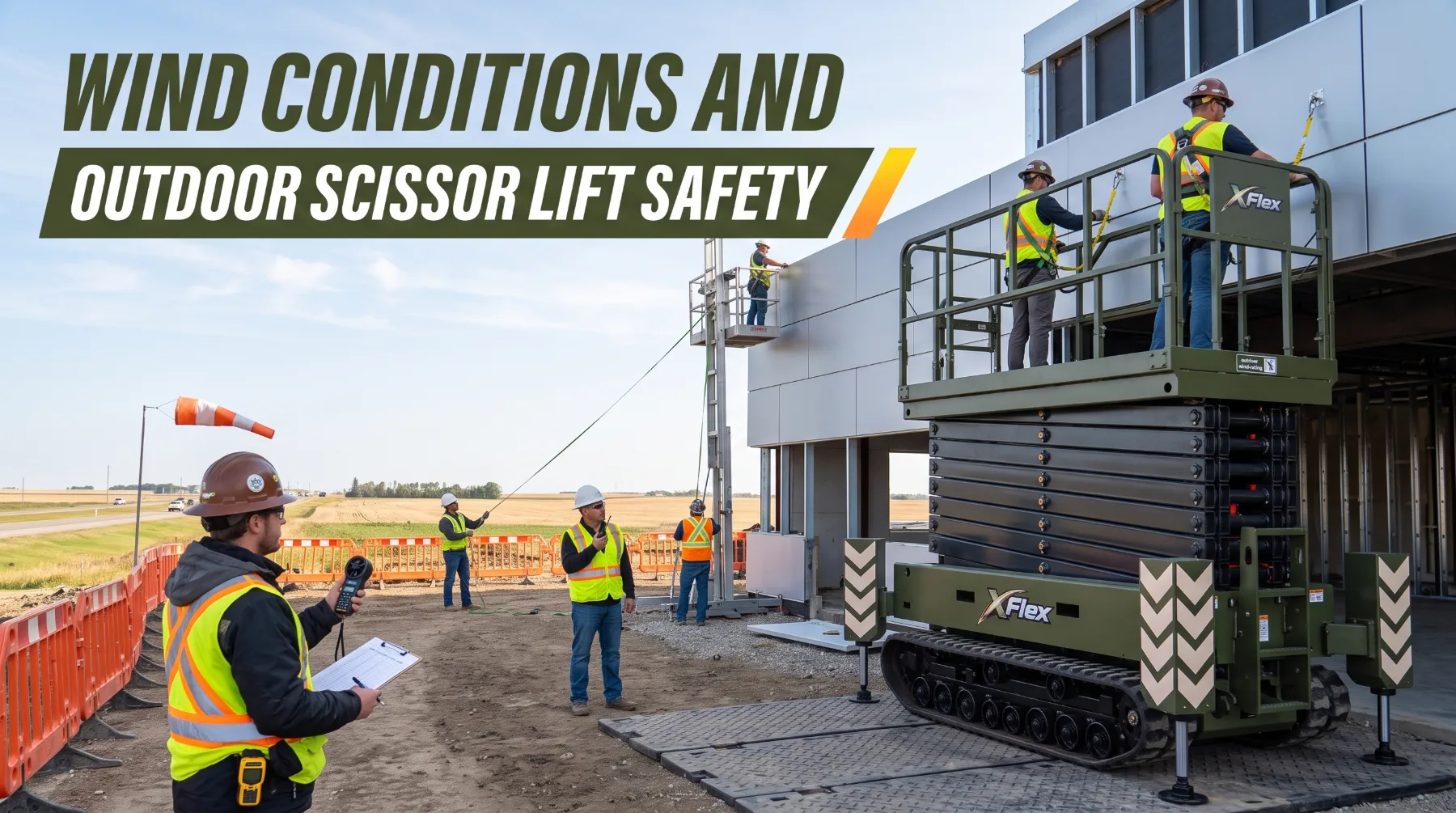
Outdoor scissor lifts allow crews to complete facade installation, maintenance, and repair work at height, but changing wind conditions can affect platform stability and worker safety. Large panels and other sheet materials can catch the wind like sails, creating unexpected forces even when ground-level conditions seem manageable. Open sites, building corners, and breezeways may expose elevated workers to stronger gusts than they experience on the ground.
Manufacturer wind limits, outdoor platform capacity, total load weight, and material dimensions all influence safe operation. Wind speed can vary with elevation and building layout, while soft backfill, uneven ground, or settling tires can further compromise lift stability. Operators need to understand the machine's restrictions, monitor wind conditions at platform height, and recognize when large materials require separate lifting equipment.
Safe outdoor lift operation depends on checking the manual and platform decals, establishing clear stop-work thresholds, and monitoring gusts throughout the shift. Crews should use firm, level ground, secure the work area, and avoid carrying large wind-catching panels on a scissor lift unless the manufacturer explicitly permits it. Regular inspections, suitable material-handling methods, and a clear emergency response plan help workers manage changing site conditions without compromising safety.
Understanding Manufacturer Wind Limits
Every scissor lift has specific operating conditions and limitations, and wind is one of the most important. The manufacturer sets these limits based on the machine's design, its stability testing, and the configuration in which it's used. Some scissor lifts are rated only for indoor use, which means they're designed to operate with no wind at all. Outdoor-rated models carry a maximum permitted wind speed, and many are commonly rated around 28 mph, but that figure isn't universal. Some models allow less, and the limit may change with the number of occupants, the platform load, or whether an extension deck is in use.
Operators must check the model's manual and the platform markings before elevating the machine. Manufacturers usually place a decal at the control station showing whether the lift is rated for indoor or outdoor use, the maximum wind speed, the maximum number of occupants, and the rated platform capacity. On many machines, the outdoor rating comes with a lower capacity or fewer occupants than the indoor rating, because wind adds force that the machine must resist. A lift that safely carries three people indoors may be limited to two outdoors. Read every line of that decal, and confirm the numbers match the work you plan to do.
The manufacturer's wind limit also refers to a specific measurement. In most cases, it describes wind speed at the platform's working height, including gusts, not the average speed reported for your town or measured at ground level. A forecast that sounds calm can still produce gusts that exceed the rating, and wind at 30 feet above the ground is often stronger than wind at head height. Treat the published limit as an absolute ceiling for conditions at the platform, never as a target to work up to.
A general wind-speed guideline should never replace the manufacturer's stated limit for the specific lift. Industry rules of thumb, a coworker's experience, and figures from a different model can all be wrong for the machine in front of you. Many contractors also set their own stop-work threshold below the manufacturer's maximum, giving the crew time to lower the platform before conditions reach the limit. That margin protects workers when gusts arrive faster than expected, as they did on the clinic project.
Key takeaway: Check the manual and platform decals for the specific lift's indoor or outdoor rating, maximum wind speed, occupant limit, and outdoor capacity before elevating, and treat that wind limit as a ceiling that general guidelines can never replace.
Measuring and Monitoring Wind
Knowing the wind limit only helps if you know the actual wind. Conditions can change throughout a shift, especially near buildings, roof edges, and exposed structures. A morning that starts calm can turn gusty by noon, and a site sheltered on one side can be wide open on another. Measuring and monitoring wind is an ongoing task, not a single check before work begins.
Start with weather information before the shift. Review the forecast for sustained wind, gusts, and changes expected during the day, and note any warnings for thunderstorms, frontal passages, or high wind. A forecast is a planning tool, though, not a measurement of your site. Local terrain, nearby buildings, and the height of the work all change what the platform actually experiences. Open land, rooftops, bridges, and coastal areas tend to see stronger, steadier wind, while urban sites can produce sudden, swirling gusts.
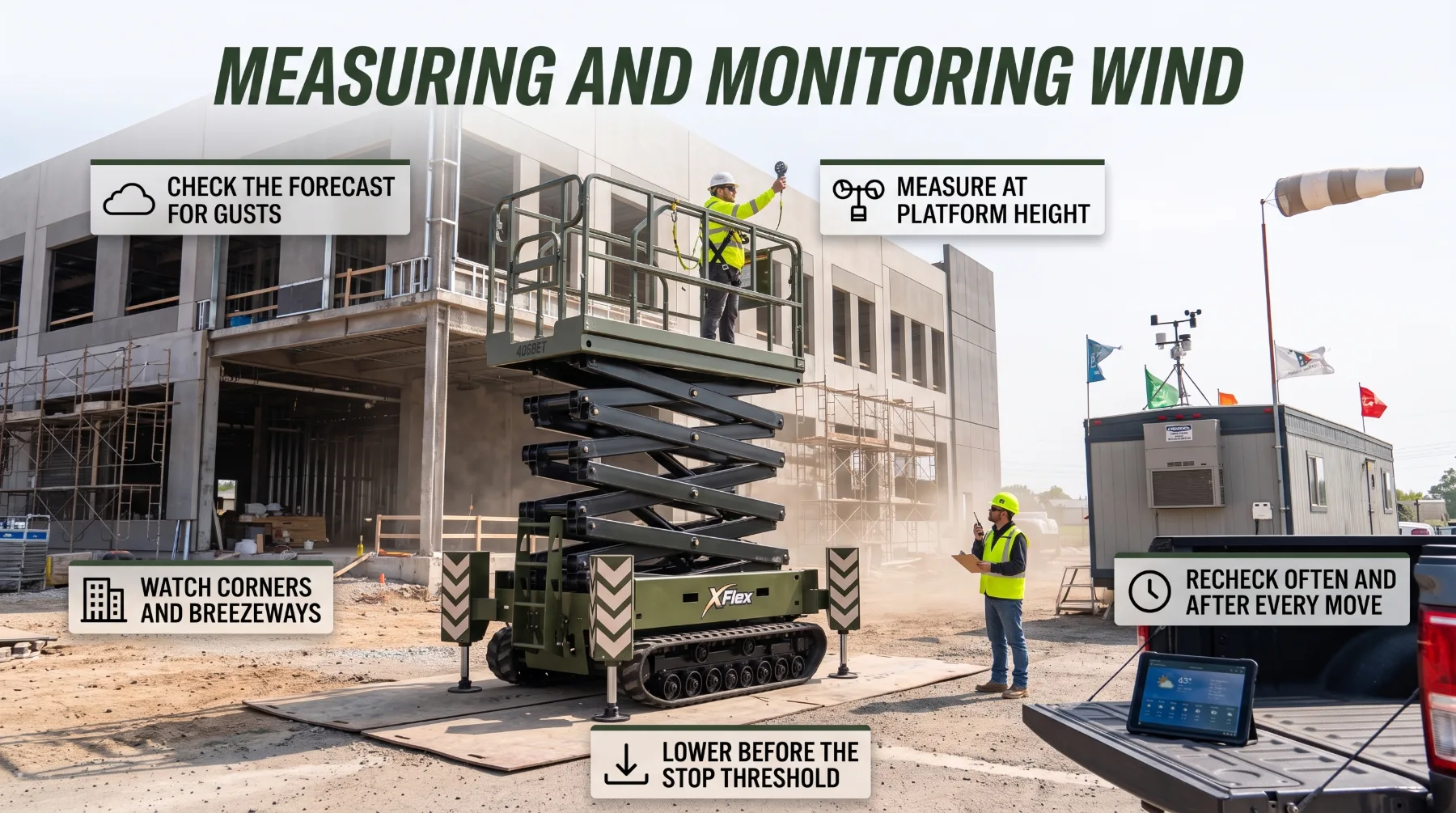
Wind can affect platform stability, especially when workers operate at height near buildings or exposed areas. Regular wind measurements and awareness of changing conditions help crews identify hazards and lower the platform before conditions become unsafe.
- Measure Wind Speed: Use a handheld anemometer or available onboard system to check wind conditions at platform height when possible. Measure before elevating, regularly during work, and whenever the lift changes position.
- Watch Building Effects: Wind can accelerate around corners, between buildings, and through narrow gaps. Reassess conditions when moving from sheltered areas to exposed locations.
- Monitor Gusts: Strong gusts can create hazards even when average wind speed seems acceptable. Watch for sudden changes and follow the lift manufacturer's wind limits.
- Recognize Warning Signs: Pay attention to flags blowing straight out, rising dust, strongly swaying branches, and loose materials moving across the site.
- Establish Stop-Work Rules: Assign an operator or supervisor to monitor wind conditions throughout the shift. If readings approach the permitted limit or conditions become unsafe, stop work and lower the platform safely.
Key takeaway: Review the forecast, then measure wind at platform height with an anemometer before and during elevated work, pay special attention to gusts and building corners, and lower the platform whenever readings approach your stop-work threshold.
Safe Platform Operation at Height
Once the platform rises, the operator's habits decide how well the crew handles changing conditions. Safe platform operation combines fall protection, careful movement, and a clear understanding of when to stop. These practices matter at any time, and they matter even more when wind is part of the day.
Guardrails are the primary fall protection system on a scissor lift. Operators should keep gates and chains closed and latched whenever the platform is elevated, and check them before raising the platform. Workers must keep both feet on the platform deck at all times. Climbing on the guardrails, standing on buckets or ladders, or using any improvised platform to gain extra height defeats the guardrail system and raises a worker's center of gravity above the rail. In the wind, that combination can pull a worker over the side. If the work can't be reached from the deck, reposition the lift or choose taller equipment.
Use the required fall protection measures for your equipment and worksite. Some manufacturers provide designated anchor points, and some employers and project owners require workers to wear a full-body harness with a restraint lanyard attached to those points. Where restraint is required, use a lanyard short enough to keep the worker inside the guardrails, attach it only to the manufacturer's designated anchors, and never tie off to the guardrails or to an adjacent structure. Follow your company's procedures and the manufacturer's instructions together.
Movement while elevated requires particular care. The lift should not be moved while elevated unless the manufacturer specifically permits that movement under the existing conditions. Many scissor lifts allow drive at height only at reduced speed, on firm, level surfaces, and within certain height limits, and wind can make any movement more hazardous. Before driving at height, confirm the manual allows it, check the travel path for holes, slopes, and obstacles, and look overhead. Maintain the clearance from overhead power lines required by applicable regulations, which in the United States is generally at least 10 feet for lines up to 50 kV. Watch for structures, tree limbs, and other equipment that the platform could strike if it sways.
Workers should lower the platform whenever wind or other hazards exceed permitted limits. That decision shouldn't require debate. When the anemometer reads near the stop-work threshold, when gusts start pushing the platform, when lightning appears or thunder can be heard, or when rain, sleet, or ice makes the deck slippery, the right response is to secure tools and materials and lower the platform smoothly to the stowed position. Lower in a controlled manner rather than rushing, and keep workers below the platform clear of the descending machine. Resume work only after conditions return to safe levels and the crew has rechecked the ground and the wind at platform height.
Keep the area below the platform protected as well. Barricade the work zone, keep pedestrians and ground crew out from under the platform, and secure loose items on the deck so wind can't blow them over the side.
Key takeaway: Keep gates closed, stay on the platform deck, use required fall protection at designated anchors, drive elevated only when the manufacturer permits it, and lower the platform promptly whenever wind or other hazards exceed permitted limits.
Platform Load and Material Exposure
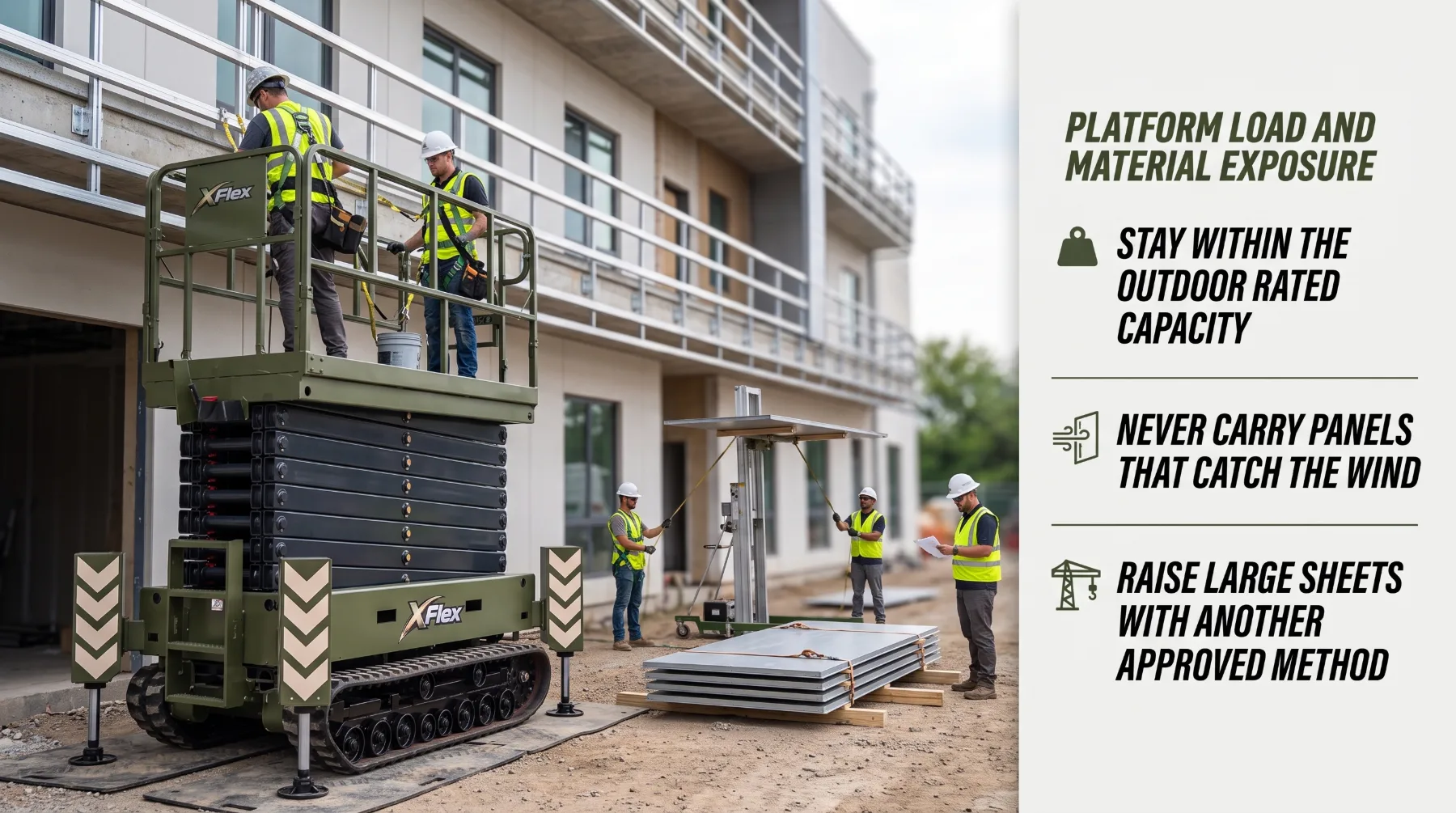
Wind doesn't act on the machine alone. It acts on everything raised with it. Workers, tools, and materials all contribute to the platform load, and many of them also add surface area that catches the wind. A scissor lift's stability depends on both the weight it carries and the wind force pushing against it, and those two factors work together in ways that can catch a crew off guard.
Begin with weight. The combined load of people, tools, and materials must remain within the lift's rated capacity, and on many machines, the outdoor capacity is lower than the indoor figure. Count everything that goes on the platform, including toolbags, fastener buckets, sealant, cords, and any material staged for installation. Distribute the load evenly across the deck rather than concentrating it at one end, and keep heavy items low and away from the guardrails. On lifts with extension decks, check whether the manufacturer limits the load on the extended section, since that area often carries less than the main deck.
Large materials create a separate hazard. Panels, plywood sheets, glass, signs, banners, insulation boards, and other broad, flat items act like sails. Even a light sheet can generate significant sideways force when wind strikes its full surface. That force pushes against the guardrails, transfers to the platform, and travels down through the scissor stack to the chassis. It can also pull a worker off balance or tear the material out of their hands, as the 4-by-10 panel did on the clinic project. Materials extending beyond the guardrails increase exposure further and can strike structures or other workers.
Many manufacturers restrict or prohibit carrying large sheet materials on the platform, or limit the size of material allowed in outdoor conditions. Some also prohibit attaching signs, banners, or other wind-catching items to the guardrails. Read the manual for these restrictions, and follow them exactly. Materials should be handled according to the manufacturer's restrictions rather than judged by weight alone, since a light panel can be more dangerous in wind than a heavy box of fasteners.
When the work requires large materials at height, plan a different delivery method. A material lift, telehandler, or crane can raise panels separately, with tag lines controlled from the ground. Work can be scheduled for the calmest part of the day, and panels can be staged in smaller pieces where the design allows. Never tie materials to the guardrails to free up your hands, and never use the platform to lift loads it wasn't designed to carry. Keep loose items secured in toolbags or containers so wind can't blow them off the deck and onto people below.
Key takeaway: Keep the combined weight of workers, tools, and materials within the lift's outdoor rated capacity, and treat large panels and sheets as wind-catching hazards that must follow the manufacturer's restrictions or be raised by another approved method.
Emergency Planning and Inspection
Before use, inspect the lift according to the manufacturer's pre-start procedure. Check tires and wheels for cuts, damage, and correct inflation where applicable, since a soft or damaged tire can tilt the machine. Inspect the platform gates, guardrails, toe boards, and anchor points for damage, missing fasteners, and secure mounting. Confirm that the gates latch and close fully. Test the platform and ground controls, the emergency stop buttons, the tilt alarm, the descent alarm, the horn, and any overload sensing system. Examine the scissor stack, pins, and hydraulic hoses for cracks, leaks, and wear, and never search for a hydraulic leak with your hands. Pressurized fluid can penetrate skin, so use a piece of cardboard instead. Confirm the decals are legible, including the wind rating and capacity information. Any defect that affects safe operation should take the machine out of service until a qualified technician completes the repair.
The emergency-lowering system deserves special attention. Every scissor lift includes a way to lower the platform when the normal controls fail, such as a manual descent valve, a release knob, or an auxiliary power function at the base of the machine. Workers should understand how to lower the platform safely if the machine stops or conditions deteriorate. Locate the emergency-lowering control, read the manufacturer's instructions for using it, and confirm that at least one trained person on the ground knows how to operate it. Test the ground controls as part of the daily inspection so the crew knows they respond.
A rescue plan and clear communication help teams respond to emergencies without improvised actions. The plan should cover how the crew will lower a stranded platform, how they'll help an injured or ill worker at height, and how they'll contact emergency services. Identify the site address, the nearest access point for emergency vehicles, and the person responsible for meeting responders. Where workers wear harnesses, the plan should address prompt rescue, since a worker suspended in a harness can develop serious medical complications in a short time. Make sure workers on the platform and the ground can communicate by voice, radio, or phone at all times, and that no one works at height alone without a way to call for help.
Record every inspection, defect, and repair in a maintenance log, along with the date and hour meter reading. Good records help the crew spot recurring problems and confirm that the machine has been checked before each use.
Key takeaway: Inspect tires, gates, guardrails, controls, alarms, and the emergency-lowering system before every shift, train ground personnel to lower the platform, and keep a clear rescue plan and reliable communication in place before anyone works at height.
Conclusion
Wind conditions are a critical factor in outdoor scissor lift operation because they affect platform stability and the safe handling of workers and materials at height. Operators must confirm the specific model's outdoor rating, maximum permitted wind speed, occupant limit, and outdoor platform capacity before work begins. Monitoring wind at platform height throughout the shift, especially near building corners, breezeways, and roof edges, helps crews identify changing conditions and sudden gusts. Large panels and sheet materials can catch the wind and create additional forces, so operators must follow the manufacturer's restrictions and use an approved alternative handling method when required. Firm, level ground, correctly positioned stabilizers where fitted, and careful platform movement help maintain stability, while staying within rated capacity prevents overloading. Before each shift, review the weather forecast for sustained winds, gusts, and storms, and establish a company stop-work threshold below the manufacturer's maximum limit. Use an anemometer to measure wind before elevating, at regular intervals, and after repositioning. Inspect the work area for soft ground, backfill, slopes, potholes, and voids, using suitable ground mats where needed, and check overhead for power lines and structures. Complete the pre-start inspection of tires, gates, guardrails, alarms, controls, and the emergency-lowering system. Confirm the required fall protection, keep gates secured, and ensure workers understand the conditions that require lowering the platform and stopping work. Assign a trained ground person and review emergency communication and rescue procedures with the entire crew before raising the platform. Regular monitoring, thorough inspections, and clear stop-work procedures help protect workers and support safe, dependable elevated work in changing outdoor conditions.
Frequently Asked Questions
Can a scissor lift operate outdoors in windy conditions?Only when the specific model is approved for outdoor use and the wind remains within the manufacturer's stated limits. Check the manual and platform decals for the maximum wind speed, which often applies to wind at platform height, including gusts. Many outdoor ratings also reduce platform capacity or occupant limits, so confirm every figure before elevating.
Why are large materials hazardous on a raised platform?They can catch the wind and create additional forces that affect platform stability. Panels, plywood, glass, and signs act like sails, pushing against the guardrails and pulling workers off balance. Many manufacturers restrict or prohibit carrying large sheet materials, so follow those limits and use another approved lifting method when needed.
Should a scissor lift move while elevated?Only if the manufacturer permits it and all specified operating conditions are met. Many lifts allow elevated travel only at reduced speed on firm, level ground and within certain height limits. Check the travel path and overhead clearances first, and avoid elevated movement whenever wind or ground conditions add risk.
What should operators do if wind increases beyond the permitted limit?They should stop elevated work, secure tools and materials, and lower the platform safely according to the manufacturer's procedure. Lower smoothly, keep people below clear of the machine, and resume work only after wind measured at platform height has returned to safe levels and the ground has been rechecked.